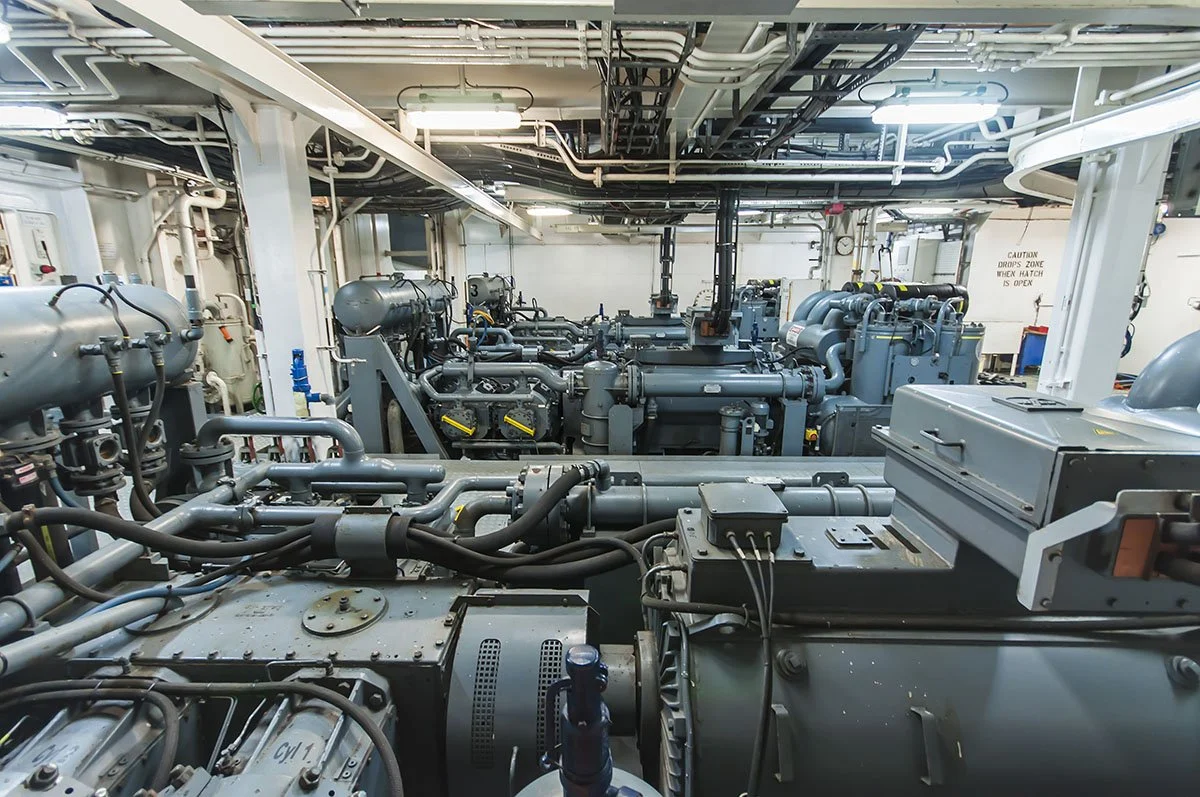
Sound is a constant presence in engine and machinery spaces. But what happens when equipment begins to deviate from normal operation? Often, the earliest indication is a change in sound; subtle shifts that develop over time, or distinct acoustic events that signal emerging faults.
Replacing Engine Room Rounds with Acoustic Intelligence
In engine and machine rooms, sound has always been one of the most important sources of information. Experienced engineers develop an intuitive understanding of how machinery should behave, and can often detect faults simply by listening.
But this form of monitoring depends entirely on human presence. Someone needs to be there at the right time, able to hear and interpret what is happening. This is particularly relevant in modern maritime operations, where vessels are moving toward reduced crew, autonomous operation, or unattended machinery spaces (UMS). In these cases, continuous human monitoring is no longer feasible.
This is where Acoustic Asset Management becomes essential. It introduces a persistent layer of awareness that operates independently of crew presence, ensuring that changes in machinery behavior are detected even when no one is there to listen.
Squarehead’s technology builds on the same principle as human hearing, but extends it beyond human limitations. Using acoustic microphone arrays, the system captures and processes sound in complex, noisy environments, enabling a single array to monitor an entire machinery space. The result is what we call superhearing: the ability to isolate and analyze individual sound sources with a level of clarity and consistency that is not possible with human perception alone.
In effect, Acoustic Asset Management replaces and enhances intermittent human listening with continuous, real-time digital awareness.
Understanding what “normal” sounds like
At the core of the system is a simple idea: before detecting faults, you must first understand normal operation.
The system continuously listens to the machinery space and builds a digital model of its acoustic behavior. Over time, it learns how the environment typically sounds across different operating conditions and time periods, creating a digital representation of what an experienced engineer would describe as “normal.”
Each new sound is then evaluated against this learned baseline of normal sound patterns. If it behaves as expected, it is ignored. If it deviates, it is flagged.
This approach does not require predefined fault signatures or labeled data. Instead, it detects changes in behavior, making it particularly well suited for complex systems where failures are rare, unpredictable, or previously unseen.
From anomaly detection to actionable insight
When an anomaly is detected, the system does more than raise an alert. It automatically triggers recordings and allows operators to investigate the event in detail.
Because the array can isolate sound spatially, users can listen directly to the source of the anomaly and pinpoint its exact location within the machinery space. This creates a direct link between detection and verification, enabling faster and more confident decision-making.
In practice, this means that events which would otherwise go unnoticed, because they are intermittent, masked by noise, or occur between inspection rounds, can be captured and understood.
Why Acoustic Monitoring?
Acoustic monitoring enables continuous insight into machinery health by detecting subtle changes in sound that may indicate emerging faults. Through Acoustic Asset Management, these changes can be identified, located, and investigated in real time, even in noisy or unattended machinery spaces. This supports earlier fault detection, faster decision-making, and more reliable operations, while reducing the need for manual inspections and minimizing unplanned downtime.
-
Acoustic Asset Management is a method of monitoring machinery by continuously analyzing sound. Squarehead uses advanced microphone arrays to detect changes in acoustic behavior, enabling early identification of faults without relying on human presence.
-
Traditional systems rely on predefined sensors and thresholds for specific parameters like temperature or vibration. Instead, Acoustic Asset Management listens holistically, detecting deviations from normal sound patterns, even for unknown or unexpected faults.
-
Sound carries rich information about mechanical behaviour. Changes in tone, frequency, or rhythm can reveal issues early, often before they are visible in other sensor data.
-
Yes. By using large microphone arrays and advanced signal processing, the system can isolate and analyze individual sound sources even in complex, high-noise environments.
-
It provides continuous monitoring without requiring human presence, ensuring that anomalies are detected and recorded even when machinery spaces are unattended.